
Where should the next plant factory be built?
We track food-security investment, public tenders, water stress, produce prices, solar potential and real buyer interest to identify cities where controlled-environment agriculture can create the strongest impact and return.
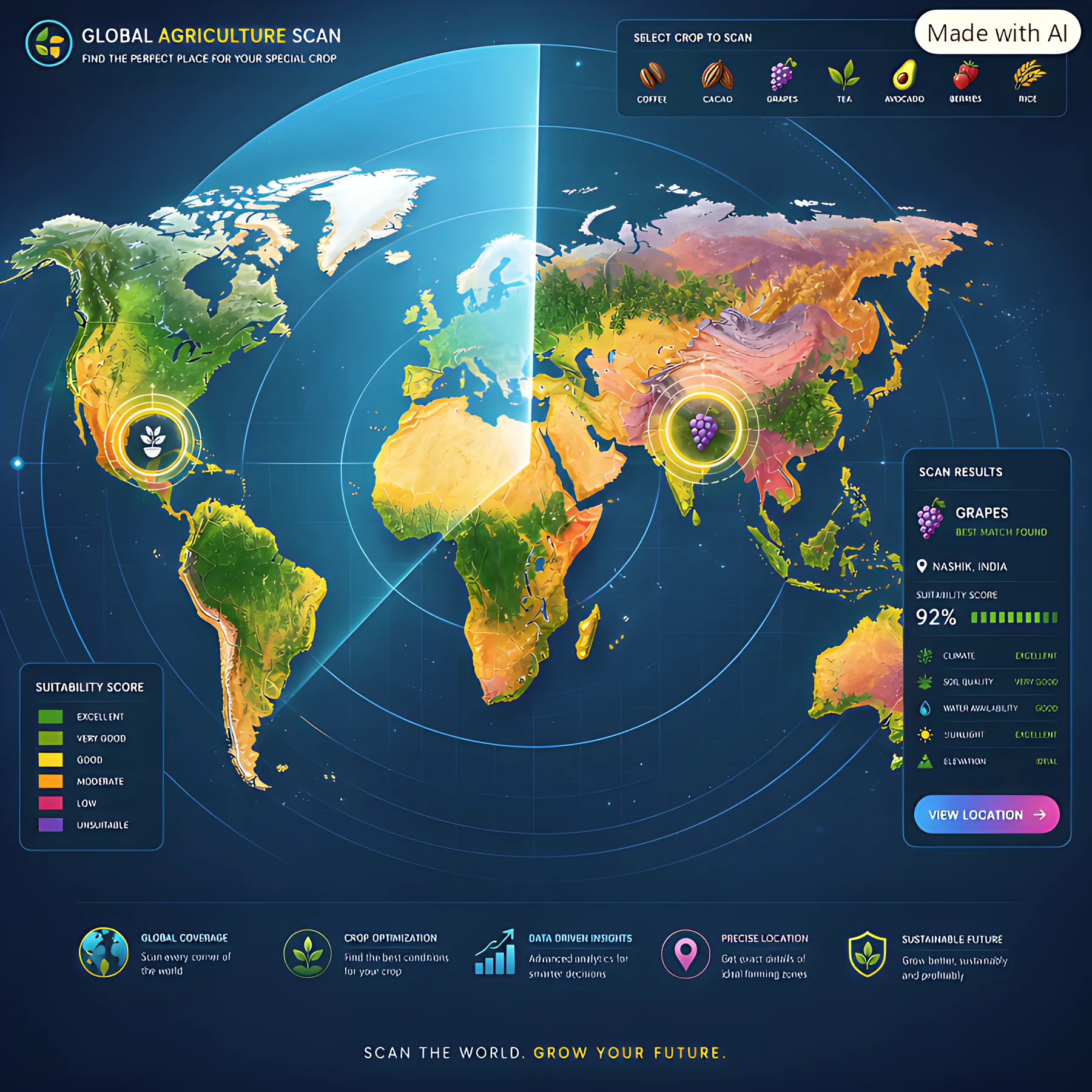
Run a preliminary location scan
Combine live NASA climate and solar data with your energy, buyer, power and budget inputs. Results are a screening signal—not investment advice.
Climate data is cached for 12 hours to keep the free service fast.
From global need to investable opportunity
A country may urgently need local food production but still lack an active budget, procurement route or capable buyer. Our radar separates Need Score from Investment Intent and Commercial Access.
Djibouti
High intent
Official investment cases reference climate-adapted greenhouses, soilless cultivation and automated fertigation – a strong technology-fit signal.
Rwanda
High intent
Recent institutional cost-benefit work on hydroponic production indicates policy awareness and an evidence-led investment environment.
Cabo Verde & African SIDS
Emerging
Island food-import exposure, tourism demand and strong solar potential make modular local production strategically relevant.
Guatemala
Emerging
Government-level agrifood investment participation plus a direct market lead justify a focused city-level feasibility scan.
Southern Africa
Emerging
Large agrifood investment pipelines and renewable-energy agriculture programmes create partnership and demonstration opportunities.
Gulf markets
Watch
High food-security relevance and purchasing capacity remain attractive, while commercial-access and execution risks are monitored separately.
What moves a market up the radar?
Budget & procurement signals
Active tenders, RFPs, grants, public budgets and investment cases.
Food-security need
Import dependence, water stress, produce-price volatility and supply-chain exposure.
Technical and energy fit
Grid quality, solar potential, local climate, logistics and service readiness.
Commercial access
Payment route, legal access, local partner capacity and buyer affordability.
First-party demand
City-scan requests, qualified enquiries, partner applications and buyer engagement.
Actionable plant-factory signals
We separate active procurement from funded programmes, partnership openings and policy signals. Every item links to first-party evidence and carries a verification date so an old pilot is never presented as a live tender.
Vertical farming has moved from demonstration to public-sector adoption
FAO installed a hydroponic vertical farm at MINAGRI, trained 39 young agripreneurs and stated its interest in expanding vertical-farming and hydroponic technologies with development and resource partners.
Official development analysis explicitly identifies vertical farming
AfDB’s country analysis identifies vertical farming, hydroponics and smart agriculture as responses to limited arable land, import exposure and food-security risk. Best route: local feasibility partner plus hospitality and public-sector buyers.
Solar-powered commercial hydroponics is already receiving UN support
A 2026 UNDP/GEF-backed community farm combines commercial hydroponics, rooftop solar, rainwater harvesting, training and women’s livelihoods—the same integrated logic needed for island plant-factory deployment.
Self-powered vertical hydroponics matches the FVS solar-ready model
The programme demonstrates an agro-photovoltaic, self-powered vertical hydroponic system with training, low-water production and community employment. It is a strong technical and humanitarian replication signal.
AfDB has already financed water-efficient urban vertical hydroponics
The precedent validates both the technology category and a grant-backed path for youth-led urban production. Recommended action: identify a credible Nigerian consortium and buyer before pursuing finance.
Food, water and energy are being evaluated as one investment system
AfDB’s WEFE Nexus Investment Framework creates a relevant entry point for solar-ready, water-efficient plant factories. These are programme signals—not active tenders—and require country-specific partners and buyer validation.
Status rule: a funded pilot or policy document is evidence of institutional intent, not an open procurement notice. Live tenders will be labelled separately and will include a deadline and eligibility check.
Turn a screening score into an evidence-backed decision
Use the live preliminary scan above for an immediate signal. When a location looks promising, request a documented review of procurement activity, buyer readiness, energy, logistics, pricing and deployment risks.
List your company free during launch
Technology providers, growers, researchers, investors and service companies can request a verified profile. Ranking and evidence-based evaluation remain independent of payment.
Share an investment signal
Government teams, development agencies, universities and investors can submit a programme, tender or city initiative for inclusion in the radar.
Follow the institutional opportunity route
Understand UNGM registration, FAO vendor readiness, evidence requirements and the procurement signals that can move a country up the radar.
Phase-one scores combine user assumptions with editorial research indicators based on public evidence and direct market signals. Evidence sources include FAO, UNGM, World Bank, UN Comtrade, African Development Bank, public authorities and verified first-party enquiries.